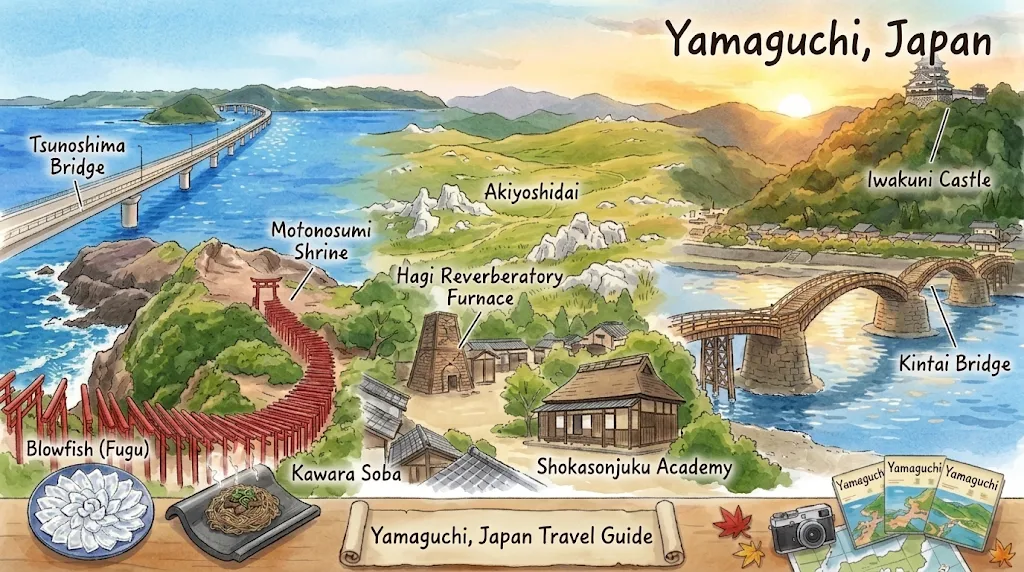
At the western tip of Honshu, Yamaguchi Prefecture combines Meiji Restoration history in Hagi, wooden bridge engineering in Iwakuni, karst landscapes in Akiyoshidai, and dramatic Sea of Japan coastlines. Because sights are spread across wide areas with varying rail and bus access, planning routes and transport ahead saves time. Here is a practical guide to key spots, getting around Yamaguchi, and a sample 1-day itinerary.
🚄 Getting Around Yamaguchi
Shin-Yamaguchi Station is a main Sanyo Shinkansen hub for central and western Yamaguchi, while Shin-Iwakuni Station serves the eastern side near Iwakuni. Coastal viewpoints like Tsunoshima and Motonosumi Shrine are often easier by rental car, tour, or timed bus/taxi connections than by train alone.
| Destination Area | Typical Transit Route | Approx. Travel Time |
|---|---|---|
| Akiyoshidai & Akiyoshido Cave | Bus from Shin-Yamaguchi Station toward Akiyoshido, or rental car | ~40–50 mins from Shin-Yamaguchi |
| Hagi Heritage Sites | Direct/local bus or JR train/bus connections from Shin-Yamaguchi toward Hagi, or rental car | ~60–80 mins from Shin-Yamaguchi |
| Kintaikyo Bridge (Iwakuni) | Sanyo Shinkansen to Shin-Iwakuni Station + bus (~15 mins), or JR Sanyo Line to Iwakuni Station + bus (~20 mins) | ~15–25 mins from station + transfer |
| Tsunoshima Bridge & Motonosumi Shrine | Rental car, guided sightseeing tour, or JR San-in Line + local bus/taxi in Nagato/Shimonoseki area | ~1.5–2.5+ hrs (varies by starting point & transit) |
Practical note: Because Yamaguchi spans long distances, avoid packing Iwakuni in the far east and Tsunoshima/Motonosumi in the northwest into the same day without a fast rail/car plan.
📍 Key Sights, Coastlines & Local Food
🏭 Hagi Meiji Industrial Heritage (Shokasonjuku Academy & More)
In Hagi, sites inscribed under the UNESCO World Heritage listing for Sites of Japan’s Meiji Industrial Revolution include Shokasonjuku Academy (associated with Yoshida Shoin), the Hagi Reverberatory Furnace, and Ebisugahana Shipyard[cite: 17].
Practical tip: Hagi’s heritage sites are spread across several neighborhoods—renting a bicycle or using local buses/walking maps helps connect them efficiently, and checking opening hours in advance avoids closed-facility surprises.
🌉 Kintaikyo Bridge (Iwakuni)
Spanning the Nishiki River in Iwakuni, Kintaikyo Bridge is a five-arch wooden bridge built using traditional carpentry joinery without nails in the main arches, with Iwakuni Castle above on the hill[cite: 17].
Practical tip: Crossing the bridge requires a small admission/tolling ticket (often available around the clock at ticket booths/machines), and the arched wooden slats have stepped cleats—wear comfortable, non-slip shoes and watch your step.
⛰️ Akiyoshidai Plateau & Akiyoshido Limestone Cave
Akiyoshidai features exposed limestone karst formations across rolling hills, with Akiyoshido Cave running beneath it with large underground chambers and limestone rimstone formations[cite: 17].
Practical tip: Inside Akiyoshido Cave, temperatures stay relatively cool year-round (around 17°C/63°F) and pathways can be damp or uneven—bring a light jacket even in warm weather, wear grippy walking shoes, and check cave closing/last-entry times.
🌊 Tsunoshima Bridge & Motonosumi Shrine
Along Yamaguchi’s Sea of Japan coast, Tsunoshima Bridge spans clear blue coastal waters to Tsunoshima Island, while Motonosumi Shrine features a line of red torii gates descending toward the ocean cliff[cite: 17].
Practical tip: Both spots are popular for photography and can have limited parking or narrow coastal roads—drive carefully, follow visitor/parking rules, stay back from cliff edges and surf, and check bus schedules if not driving.
🐡 What to Eat: Fugu (Pufferfish) & Kawara Soba
Yamaguchi is known for fugu (pufferfish, especially associated with Shimonoseki, prepared by licensed chefs as sashimi, hot pot, or fried karaage) and kawara soba (green tea soba noodles seared on a hot roof tile with beef, egg strips, and lemon)[cite: 17]. Fugu courses and specialties can vary by season and restaurant, so check menus or reserve ahead if trying a dedicated fugu meal.
🗓️ Sample 1-Day Itinerary: Akiyoshidai & Hagi
Because Iwakuni is on the far eastern side and Tsunoshima/Motonosumi sits in the northwest, grouping nearby central/northern stops like Akiyoshidai and Hagi makes a realistic 1-day loop[cite: 17]:
- 09:00 – Akiyoshidai & Akiyoshido Cave: Explore the underground limestone cave and above-ground karst plateau in the morning[cite: 17].
- 11:45 – Lunch & Drive/Bus to Hagi: Have lunch and head north toward Hagi[cite: 17].
- 13:30 – Hagi Heritage & Historic Streets: Visit Shokasonjuku Academy and nearby Meiji industrial or samurai-town spots[cite: 17].
- 16:00 – Cafe or Local Sweets Break: Rest and browse local shops before heading back[cite: 17].
- 18:00+ – Return & Dinner: Head back toward Shin-Yamaguchi or your hotel and try kawara soba or local seafood[cite: 17].
Plan Your Stay & Passes in Yamaguchi
Compare hotels and ryokan in Hagi, Yuda Onsen, or Shimonoseki, and check tours or rail passes.