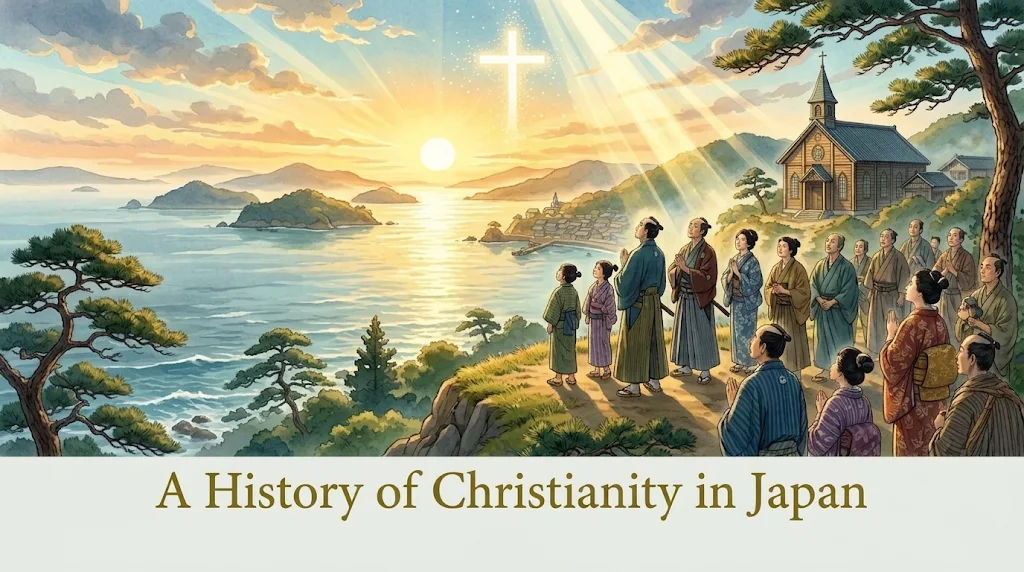
A History of Christianity in Japan
Introduction: The Paradox of Christianity in Japan
Japan is widely known as a nation of Shinto and Buddhism. Today, Christians make up barely 1% of the Japanese population. Yet, the history of Christianity in Japan is one of the most dramatic, bloody, and profoundly moving chapters in the nation’s history. From the rapid conversions of samurai lords in the 16th century to brutal centuries of persecution, the miraculous survival of “Hidden Christians,” and the deep influence on modern Japanese education and culture, the story of the cross in Japan is entirely unique.
Furthermore, while the Christian population remains small, modern Japanese society enthusiastically embraces Christian-style weddings, Christmas, and Valentine’s Day. To understand Japan fully, one must understand this fascinating 450-year journey of adaptation, resistance, and assimilation.
Chapter 1: The Arrival and the Christian Century (1549–1587)
The story begins in August 1549, when the Jesuit missionary Francis Xavier landed in Kagoshima, at the southern tip of Kyushu. Japan was in the midst of the Sengoku (Warring States) period, a chaotic era of endless civil war. Xavier and his successors brought not only a new faith but also European culture, advanced knowledge of astronomy and medicine, and crucially, access to Portuguese trade, including highly coveted firearms (matchlock guns).
For many regional warlords (Daimyo), embracing Christianity or welcoming missionaries was a strategic political and economic move. Some Daimyo, however, truly converted and were baptized, becoming known as “Kirishitan Daimyo” (Christian Lords). Notable figures included Omura Sumitada, who opened the port of Nagasaki to foreign trade, and Takayama Ukon, a master of the tea ceremony who famously chose his faith over his domain.
The Jesuits adapted to Japanese culture, wearing silk robes resembling Buddhist monks and studying the language diligently. By the early 1580s, it is estimated that there were over 200,000 Christians in Japan, and Nagasaki had effectively become a thriving “Christian City,” occasionally referred to as the Rome of Japan.
Chapter 2: The Turning Point and the Era of Martyrs (1587–1638)
The rapid expansion of Christianity alarmed the supreme unifier of Japan, Toyotomi Hideyoshi. He suspected that the foreign missionaries were the vanguard of Spanish or Portuguese military conquest. Furthermore, the Christian teaching that all humans were equal before God directly threatened the rigid feudal hierarchy. In 1587, Hideyoshi issued the Edict Expelling Jesuit Missionaries.
In 1597, Hideyoshi ordered the crucifixion of 26 Christians in Nagasaki. Today, they are globally venerated as the “26 Martyrs of Japan.” This marked the beginning of severe, systematic persecution.
The Tokugawa Shogunate, which took control in 1603, was even more ruthless, issuing a nationwide ban on Christianity in 1614. The climax of this tension was the Shimabara Rebellion (1637–1638), where heavily taxed peasants and masterless samurai, largely Christian, rose up. The rebellion was brutally crushed, resulting in the massacre of some 37,000 people. Following this trauma, the Shogunate enforced the “Sakoku” (Closed Country) policy, cutting off almost all contact with the West.
Chapter 3: The Silence and the “Hidden Christians” (17th–19th Century)
For over 200 years, Christianity in Japan completely vanished from the public eye. The government utilized a system called “Fumie”—forcing citizens to trample on bronze images of Jesus or Mary to prove they were not Christians. Those who refused were tortured or executed.
However, in the isolated fishing villages and islands of Nagasaki, such as the Goto Islands, the faith survived entirely underground. These believers became known as the “Kakure Kirishitan” (Hidden Christians). To avoid detection, they disguised the Virgin Mary as the Buddhist deity Kannon (“Maria Kannon”). They memorized prayers combining Latin, Portuguese, and Japanese, passing them down orally from generation to generation behind closed doors.
Chapter 4: The Miraculous Discovery and Meiji Restoration
In 1853, Commodore Matthew Perry’s black ships forced Japan to open its borders. In 1865, a French priest named Bernard Petitjean built Oura Church in Nagasaki. One day, a group of local Japanese peasants approached him. An elderly woman whispered, “The heart of all of us here is the same as yours. Where is the image of Santa Maria?” Petitjean was utterly shocked. He had discovered the descendants of the Hidden Christians who had preserved their faith for 250 years.
Chapter 5: Modernization, Protestantism, and Social Impact
While Catholicism was rooted deeply in Kyushu, the Meiji period brought Protestant missionaries to Japan. Christianity in modern Japan became synonymous with advanced Western civilization, modern education, and social reform. Christian missionaries and Japanese converts established some of Japan’s most prestigious universities, such as Doshisha University and Sophia University, and pioneered higher education for women.
However, as Japan rapidly militarized in the 1930s, tension arose again. The government mandated worship of the Emperor as a living god under “State Shinto.” Christians faced a severe dilemma, and during World War II, many Christian leaders were imprisoned for their pacifist stances.
Chapter 6: Post-War Era and the Cultural Phenomenon
Following World War II, the 1947 Constitution guaranteed absolute freedom of religion. Yet, the Christian population plateaued at around 1% of the total population, where it remains today.
So, did Christianity fail in Japan? Not quite. Its influence is profoundly woven into modern Japanese society in a uniquely syncretic way. Today, over 60% of Japanese couples choose to have a “Christian-style” wedding in a chapel. Christmas is one of the most celebrated events of the year, viewed as a romantic holiday for couples to eat fried chicken and strawberry shortcake. St. Valentine’s Day has been enthusiastically adopted as a massive chocolate-gifting cultural event.
Conclusion: A Legacy Carved in Stone and Spirit
In 2018, the “Hidden Christian Sites in the Nagasaki Region” were inscribed as a UNESCO World Heritage site, permanently recognizing the incredible resilience of Japan’s clandestine believers.
The history of Christianity in Japan is not a simple story of Western expansion. It is a deeply Japanese story of political maneuvering, unimaginable endurance, intellectual modernization, and cultural remixing. While the churches in Japan might not be filled with worshippers on a Sunday morning, the legacy of the cross is permanently embedded in the schools, the hospitals, the literature, and the fascinating cultural calendar of modern Japan.
Guide to Our Portal Site
On this blog, we aim to share useful information for foreigners in Japan. Thank you for your support.
Life Support NAVI Top Page