Kobo Daishi (Part 1): The Boy Named Mao and the Awakening at Cape Muroto
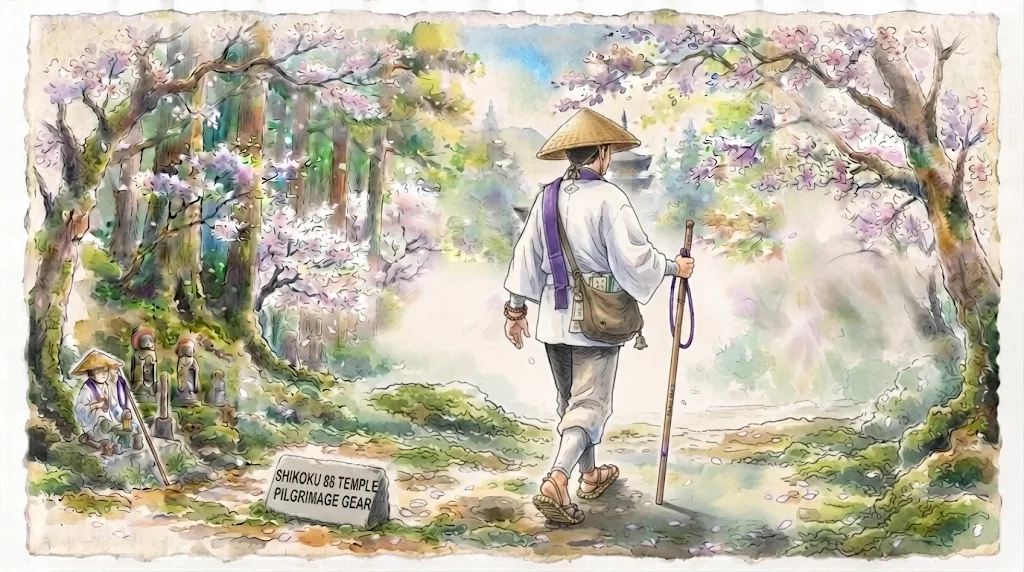
To understand the Shikoku Pilgrimage, one must first look at the life of its founder, Kobo Daishi. Born in 774 AD, he is widely regarded as one of the most influential monks and scholars in Japanese history. His journey from an elite aristocrat to a mountain ascetic changed the spiritual landscape of Japan forever. This is the story of how a young man abandoned everything to seek the truth.
The Birth of Mao
He was born into the prestigious Saeki clan in Sanuki Province (modern-day Kagawa Prefecture). Given the childhood name Mao (True Fish), he was recognized early on as a prodigy. Legends say his mother dreamt of an Indian holy man entering her womb before his birth. From a young age, Mao displayed a deep intellect and a strong sense of empathy.
Dropping Out of the Elite Path
At 18, Mao moved to the capital to enter the National University, an institution designed to train future government officials. He studied Confucianism and classical texts, but soon felt a deep sense of emptiness. He realized that secular laws could govern a country, but they could not save people from spiritual suffering. Shocking his family, he dropped out of the university and disappeared into the mountains.
Training in the Wilderness
Seeking true power, the young ascetic returned to Shikoku. He chose the most dangerous mountains, such as Mount Tairyu and Mount Ishizuchi, for his training. He practiced a rigorous esoteric method known as Gumonji-ho, which involved reciting a specific mantra one million times over several weeks, often in extreme isolation. Through this severe physical and mental training, he forged a deep connection with nature.
The Miracle at Mikurodo and the Name Kukai
The turning point of his early life happened at Cape Muroto. Meditating in a small coastal cave called Mikurodo, he pushed himself to the absolute limit. While there are various theories and debates among historians about what exactly he experienced in that extreme state, the legend describes an awe-inspiring miracle. As he chanted his final mantras, the Morning Star is said to have flown into his mouth, bringing him ultimate enlightenment. Looking out from the cave, he saw nothing but the sky and the ocean. Inspired by this sight, he abandoned the name Mao and called himself Kukai (Ku meaning “Sky” and Kai meaning “Sea”).
Kobo Daishi (Part 2): The Journey to Chang’an and the Three-Month Miracle
After his awakening at Cape Muroto, Kukai realized that to truly help people, he needed to master the systematic teachings of Esoteric Buddhism. In 804 AD, at the age of 31, he joined the imperial mission to Tang Dynasty China. This journey would lead him to the greatest metropolis in the world and an encounter that would change Japanese history.
Crossing the Stormy Seas
Crossing the ocean to China in the 9th century was an extremely perilous undertaking. Many ships were destroyed by typhoons, and Kukai’s fleet also faced severe storms. Despite the dangers, his ship managed to reach the continent. He then traveled over land to Chang’an (modern-day Xi’an), which was the cultural and religious center of Asia at the time.
“I Have Been Waiting for You”
In Chang’an, Kukai visited Qinglong Temple to meet Master Huiguo, the supreme patriarch of Esoteric Buddhism. Master Huiguo had thousands of disciples, but according to historical records, the moment he saw the unknown monk from Japan, he smiled and said, “I knew you would come. I have been waiting for you.” He immediately recognized Kukai as his true successor.
The Three-Month Miracle
As a state-sponsored student, Kukai was expected by the Japanese government to study in China for 20 years. Master Huiguo, however, began pouring all his knowledge into Kukai right away. While there are various theories regarding how a human mind could process such an immense amount of information, Kukai absorbed the massive texts and secret rituals at an incredible speed. Miraculously, he mastered the entirety of Esoteric Buddhism in just three months.
Bringing the Universe Back to Japan
Shortly after passing on his lineage to Kukai, Master Huiguo passed away. Having achieved his goal far ahead of schedule, Kukai decided to return to Japan after only about two years. He brought back not only scriptures but also the Mandala—a profound visual map of the universe. This concept of the universe deeply influenced the Shikoku Pilgrimage, transforming it into a journey through a living Mandala.
Kobo Daishi (Part 3): The Visionary’s Return and the Polymath’s Miracles
Returning to Japan with the ultimate secrets of the universe, Kukai did not receive a hero’s welcome. Because he returned 18 years earlier than the government had ordered, he was initially treated as a state criminal. Yet, his unmatched genius could not be hidden for long. This is the untold chapter of how the visionary monk transformed into a legendary architect, engineer, and savior of the common people.
The Exile and the Emperor’s Call
For several years after his return, Kukai was stranded in Kyushu, forbidden from entering the capital in Kyoto. However, rumors of the brilliant monk who mastered Esoteric Buddhism in just three months reached Emperor Saga. Recognizing Kukai’s extraordinary intellect and his profound mastery of calligraphy, the Emperor pardoned him. Kukai was finally invited to the center of Japanese politics, where he quickly outshined the established religious elites.
The Architect of Manno Lake
Kukai was not just a profound philosopher; he was a polymath who brought advanced civil engineering techniques from China. When a massive reservoir in his home province of Sanuki, called Manno Lake, collapsed and caused severe floods and droughts, the government failed to rebuild it. The desperate local peasants begged for Kukai’s help. Using cutting-edge arch dam designs he observed in China, he directed the reconstruction and successfully rebuilt the unbreakable dam in just a few months. He saved countless lives not through prayer alone, but through practical science.
Education for Everyone
During this period, education was a privilege reserved strictly for wealthy aristocrats. Kukai, remembering the suffering he saw in his youth, shattered this rule. He established the Shugei Shuchiin in Kyoto, the very first public school in Japan that opened its doors to ordinary citizens regardless of their social class or wealth. While history debates how one man could achieve so much across religion, engineering, and education in a single lifetime, his actions during this decade proved his ultimate philosophy: true enlightenment means actively helping those in front of you.
Kobo Daishi (Part 4): Koyasan and the Promise of “Dogyo Ninin”
Having established himself as a central figure in Japanese Buddhism, Kukai did not want to spend his life in the political center of the capital. He sought a quiet, remote place where people could focus purely on training and prayer. This desire led to the creation of his greatest physical legacy, and a spiritual promise that continues to comfort travelers today.
The Sacred Mountain of Koyasan
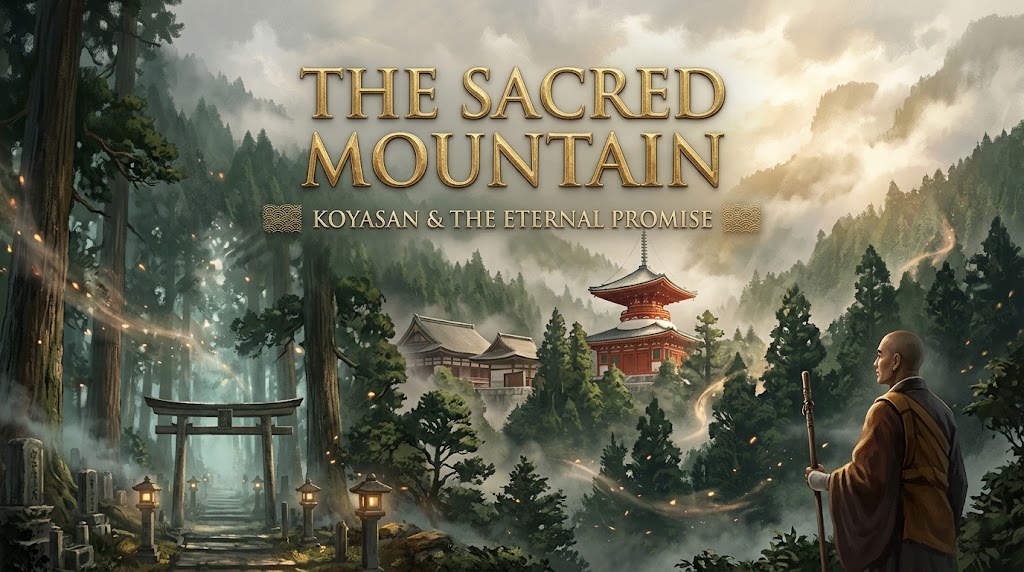
In 816 AD, Kukai was granted permission by the Emperor to build a monastery on Mount Koya (Koyasan) in Wakayama Prefecture. Surrounded by eight mountain peaks resembling a lotus flower, Koyasan was the perfect environment for his vision. He spent his later years developing this sacred mountain complex into a place of profound peace and learning, isolated from the distractions of the secular world.
Nyujo: The Eternal Meditation
In 835 AD, at the age of 62, Kukai entered a state known as Nyujo. While ordinary history books record this simply as his death, there are various theories and profound spiritual traditions suggesting otherwise. Followers of his teachings believe he did not die, but entered a state of eternal meditation inside his mausoleum at Okunoin. Even today, monks deliver meals to him twice a day, believing he is still alive and praying for the salvation of all humanity.
Dogyo Ninin: You Are Never Walking Alone
Because Kobo Daishi is eternally alive, a beautiful concept was born for the Shikoku Pilgrimage: Dogyo Ninin, which means “Two traveling together.” When you walk the 88 temples, no matter how hard the path or how heavy your heart, you are not alone. Kobo Daishi is always walking right beside you. This deeply comforting philosophy is why so many people, from all over the world and all walks of life, continue to walk the Shikoku Pilgrimage today.
Guide to Our Portal Site
On this blog, we aim to share useful information for foreigners in Japan. Thank you for your support.
Life Support NAVI Top Page