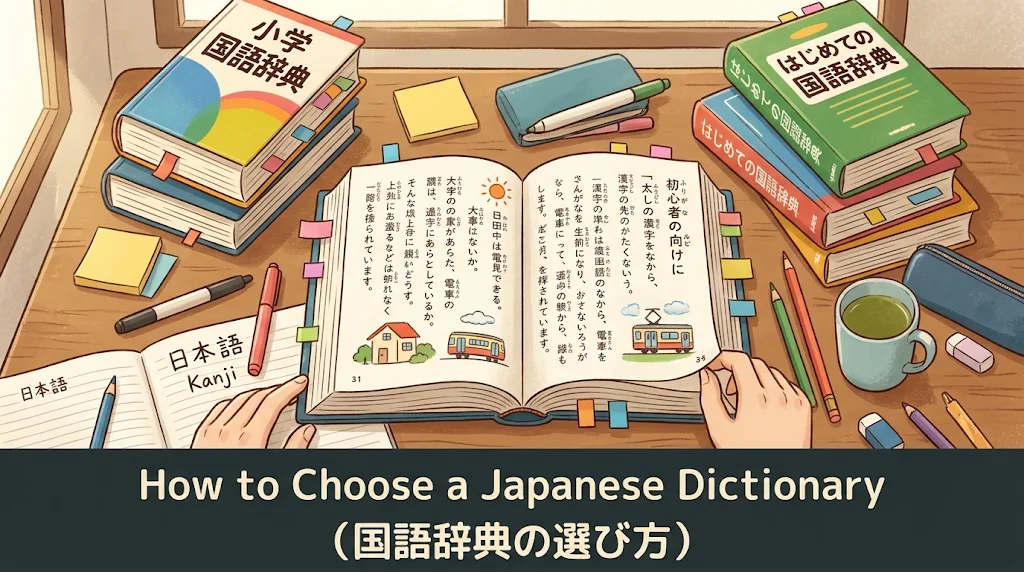
How to Choose a Paper Japanese Dictionary: The Perfect Gift for Foreign Staff and Partners
スマホより頭に入る!外国人スタッフやパートナーに喜ばれる「紙の国語辞典」の選び方
Are you looking for a meaningful gift to support foreign staff working hard at your company, or perhaps a foreign partner who is diligently studying Japanese every day? Learning Japanese is notoriously one of the most challenging endeavors, requiring the memorization of three entirely different writing systems (Hiragana, Katakana, and Kanji), along with complex grammatical structures and subtle cultural nuances.
In our highly digital modern age, where convenient translation apps like Google Translate or DeepL are readily available on our smartphones, giving a physical “paper dictionary” as a gift might seem incredibly old-fashioned or traditional at first glance. However, for serious Japanese learners who truly want to master the language, a paper dictionary is actually highly appreciated. It serves not just as a reference book, but as a powerful secret weapon for language acquisition and a tangible record of their hard work.
This comprehensive article will thoroughly explain the unique appeal of paper dictionaries for Japanese learners, highlight the common mistakes people make when choosing a dictionary as a gift, and guide you on how to choose the absolute best one to support their language learning journey and goals.
スマートフォンにGoogle翻訳やDeepLなどの便利な翻訳アプリが常備されている現代において、あえて物理的な「紙の国語辞典」を贈ることは、一見すると時代遅れに思えるかもしれません。しかし、真剣に日本語を習得したいと願う学習者にとって、紙の辞書は実は非常に喜ばれるアイテムなのです。それは単なる辞書ではなく、言語習得のための強力な「秘密兵器」であり、彼らの努力の証となります。
この記事では、日本語学習者にとっての紙の辞書のユニークな魅力、プレゼント選びで陥りがちな失敗、そして彼らの目標達成を強力にサポートするための「絶対に失敗しない選び方」を徹底的に解説します。
1. Why a Paper Dictionary instead of a Smartphone App?
なぜ今、スマホアプリではなく「紙の辞書」なのか?
While smartphones and digital dictionaries are undeniably excellent for quick, on-the-go translations, they are not always the optimal tool for deep, focused learning and long-term memory retention. Here is a detailed look at why paper dictionaries are making a significant comeback and are highly valued among dedicated language learners:
A. It Becomes a Personal “Growth Notebook”
自分だけの「成長ノート」に育つという喜び
The physical act of actively looking up a word in a book creates a much stronger memory trace in the brain compared to simply typing on a screen. With a paper dictionary, learners can use a bright highlighter on words they have searched for, write their native language translations or personal notes directly in the margins, and add colorful sticky notes for quick reference. Over months of study, the dictionary becomes noticeably thicker, heavier, and comfortably worn out. This highly visual and tactile representation of their continuous hard work provides a massive sense of accomplishment that a sterile digital screen can never offer. It stands as physical proof: “Look how much effort I have put into studying Japanese!”
B. “Detours” Dramatically Improve Vocabulary
偶然の「寄り道」が語彙力を飛躍的に高める
When you search for a specific word on a smartphone, you only ever see the exact word you typed into the search bar. The experience is linear and highly restricted. However, when you are turning the pages of a physical paper dictionary to find a target word, your eyes naturally catch neighboring words, related illustrations, and interesting synonyms. This serendipitous encounter—the “detour” of the learning process—organically and effortlessly expands a learner’s vocabulary and deepens their nuanced understanding of the Japanese language. You often learn words you didn’t even know you needed to learn.
2. Important Note: Why “Standard Adult Dictionaries” Cause Frustration
辞書選びの落とし穴:「普通の大人用辞書」は挫折の原因に
If you are planning to buy a dictionary for a foreign adult colleague or partner, your first instinct might reasonably be to purchase a standard, highly respected Japanese dictionary designed for adult native speakers (such as Kojien or Sanseido). However, it is highly recommended to avoid this common mistake!
Standard adult dictionaries fundamentally assume that the reader already knows and can comfortably read over 2,000 regular use Kanji (Joyo Kanji). Consequently, the explanation sentences utilize highly complex vocabulary, and crucially, they lack “Furigana” (the small reading aids placed above Kanji characters). If a learner looks up a new word, but cannot even read the Kanji used in the explanation itself, it leads to immediate frustration. Instead of helping, it creates a massive barrier that often causes them to give up entirely.
大人用の辞書は、読者がすでに2,000字以上の常用漢字を完全に理解し、読めることを前提として作られています。そのため、解説文には非常に難しい語彙が使われ、何より致命的なことに「ふりがな」が振られていません。せっかく新しい単語を調べたのに、その解説文に使われている漢字が読めないとなれば、すぐにフラストレーションが溜まってしまいます。学習を助けるどころか巨大な壁となり、日本語学習を諦めてしまう原因にもなりかねません。
The Ultimate Recommendation: Japanese Elementary School Dictionaries
The absolute best, most practical choice for foreign learners is a “Kokugo Jiten for Elementary School Students” (小学生向けの国語辞典). This might sound counterintuitive for an adult, but it is a game-changer. Almost every single Kanji in these dictionaries has Furigana printed next to it. Furthermore, the definitions are written in simple, clear, and highly accessible Japanese. This makes it the perfect, stress-free tool for “comprehensible input,” allowing learners to actually understand what they are reading and build confidence.
3. Top 3 Recommended Japanese Dictionaries for Gifts
プレゼントに最適!絶対に喜ばれる国語辞典 厳選3選
Here are the top three highly rated elementary dictionaries that are incredibly popular among foreign learners. They make fantastic, thoughtful gifts. You can easily purchase them through the provided links below.
1. For Beginners & Anime Fans: Doraemon Beginner’s Dictionary
【初心者・アニメ好きの方へ】ドラえもん はじめての国語辞典
If the learner has just recently memorized the basic “Hiragana” and “Katakana” alphabets, this is the perfect, welcoming starting point. Doraemon is a globally recognized cultural icon. The book is generously filled with charming Doraemon illustrations, which significantly lowers the psychological hurdle of studying. Learning alongside Japan’s beloved national character makes the difficult process of language acquisition feel more approachable and enjoyable.
▼ Check details and purchase below ▼
2. For Visual Learners: Gakken Rainbow Dictionary
【視覚から楽しく学びたい方へ】学研 新レインボー小学国語辞典
This particular dictionary is famous for its stunning, fully-colored pages and an overwhelming number of high-quality photos and detailed illustrations. For learners who easily get fatigued by looking at dense walls of black-and-white text, this dictionary can be comfortably flipped through almost like a magazine. These visual cues are incredibly helpful for quickly grasping Japanese-specific nuances, especially notoriously difficult Onomatopoeia (like “Pika-pika” for sparkling or “Mofu-mofu” for fluffy).
▼ Check details and purchase below ▼
3. The Ultimate Gift Set: Detective Conan Dictionary & Kanji Set
【本格的に学ぶ豪華ギフト】例解学習国語辞典・名探偵コナンセット
Alongside Doraemon, “Detective Conan” (Case Closed) is immensely popular worldwide and highly recognizable. This is a premium, comprehensive gift set that includes two essential books: a standard Kokugo dictionary AND a specialized Kanji dictionary, elegantly presented in a special case with a Conan tote bag. Since foreign learners struggle the most with complex Kanji stroke orders and radicals, providing them with a dedicated Kanji dictionary is incredibly supportive. If your workplace team is chipping in together, this is the ultimate supportive gift.
▼ Check details and purchase below ▼
4. Pro Tip: What to Write on the Message Card
ワンポイント:メッセージカードに添える心温まる一言
When presenting the dictionary, attaching a small, handwritten message card containing both English and simple Japanese will elevate the gesture and make the gift even more memorable and encouraging. Here is a thoughtful phrase you can use:
「これからもよろしく!いつもあなたの日本語の勉強を応援しています。」
Guide to Our Portal Site
(運営ポータルサイトのご案内)
On this blog, we aim to share useful information for foreigners in Japan. Thank you for your support.
当ブログでは、外国人の方向けの役立つ情報を発信したいと思っております。どうぞ宜しくお願いします。
(Life Support NAVI トップページ)